How Elixir Powers Real-Time FinTech and Payment Systems

When payment systems like FedNow process payments in seconds, speed and reliability are essential. That is why companies like Brex and SumUp build on Elixir.
Running on an engine designed to never stop, Elixir gives payment apps three main advantages:
- Handles thousands of transactions at once without slowing down.
- Fixes errors automatically in milliseconds, so payments keep moving.
- Grows easily across servers without complicated extra setup.
For modern payment systems, Elixir makes handling high-volume transactions simple and dependable right out of the box.
The core strengths that make Elixir the right fit for real-time financial systems:
- Concurrency at scale: millions of lightweight BEAM processes run in parallel without shared mutable state
- Fault tolerance: supervision trees restart failed processes automatically, keeping systems live 24/7
- Immutability: functional design eliminates entire classes of race conditions in concurrent transaction code
- Distributed by default: BEAM nodes communicate transparently, supporting multi-region payment deployments
- RTP and FedNow compatibility: Elixir’s always-on architecture aligns naturally with networks that require zero scheduled downtime
- Developer velocity: new engineers reach productivity in Elixir within weeks, not months
How Elixir and BEAM VM handle the technical demands of real-time payments
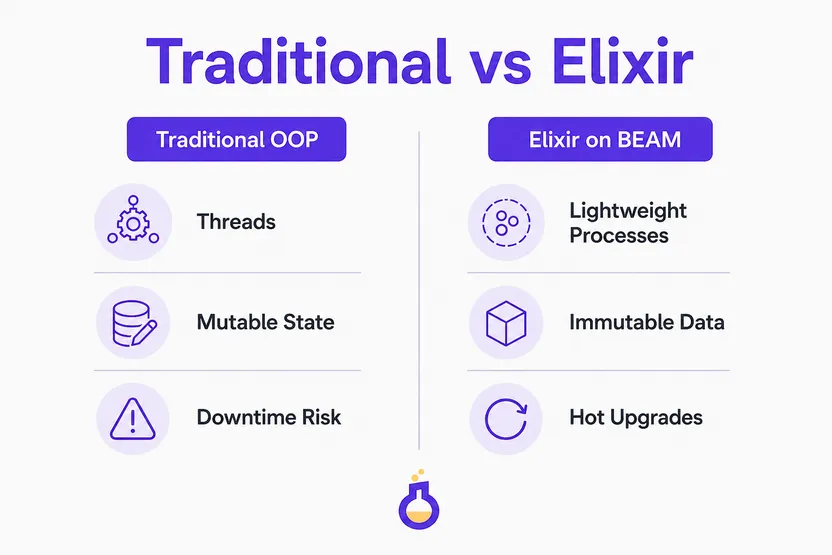
The BEAM VM does not use operating system threads the way traditional runtimes do. Instead, it schedules millions of its own lightweight processes across available CPU cores using preemptive scheduling. Each process has its own isolated heap, so a memory issue in one process cannot corrupt another. Think of it less like threads sharing a pool and more like independent workers, each with their own desk, who pass notes rather than fight over a shared whiteboard.
OTP, the standard library that ships with Erlang and Elixir, provides the building blocks that payment systems actually need. GenServers manage long-running stateful processes, like a session tracking an in-flight transaction. Supervisors watch those GenServers and restart them to a known good state if they crash. Supervision trees compose these into hierarchies, so a failure in one subsystem never cascades into a full outage.
Immutability is where Elixir’s functional design pays off most directly in financial code. When data cannot be modified in place, concurrent processes cannot produce inconsistent transaction states by stepping on each other’s writes. Pedro Franceschi, co-founder of Brex, noted explicitly that Elixir’s immutability reduces concurrency bugs and makes complex transactional states far easier to reason about.
Hot code upgrades are another BEAM capability worth naming. Elixir can load new code into a running system without restarting it, which means deploying a payment processing fix at 2 AM does not require a maintenance window. That is a meaningful operational advantage when your system is expected to be live every second of the year.
Pro Tip: When designing payment workflows in Elixir, model each transaction as a GenServer process with explicit state transitions. This makes the lifecycle auditable, restartable, and easy to monitor with tools like Telemetry and LiveDashboard.
Real-world FinTech companies already running Elixir in production
The adoption case is not theoretical. Brex and SumUp both run Elixir and Erlang at the core of their card processing and payment gateway backends, citing the BEAM VM’s distributed system capabilities as a primary reason. Brex’s engineering team has been public about the decision, and Pedro Franceschi’s account of building Pagar.me on Node.js before Brex makes the contrast clear: at Pagar.me, the team spent roughly 30% of engineering bandwidth building distributed systems infrastructure from scratch. Elixir gave Brex that infrastructure out of the box.
Luca Corti, CTO at Sibill, a FinTech startup building cash flow management software, made the case internally to rebuild on Elixir after working with a Python and TypeScript MVP. His reasoning centered on the BEAM’s real superpower: fault tolerance and resilience, not just raw concurrency. That distinction shapes how you architect a payment system. A system that recovers gracefully beats one that is fast but brittle.
The RTP network processed 142 million transactions totaling $576 billion in Q2 2026. The FedNow Service enables any eligible US depository institution to offer instant payments around the clock, every day of the year. Both networks demand backends that never go down and never lose a message. Elixir’s architecture is built around exactly that contract. You can also see how this concurrency model translates to other high-demand domains in Elixirator’s work on real-time gaming systems.
Key challenges in FinTech backends that Elixir solves directly
Payment systems face a specific set of hard problems that general-purpose backend stacks handle poorly.

Concurrency and state consistency are the first. When thousands of transactions process simultaneously, mutable shared state creates race conditions that corrupt ledger balances. Elixir’s process isolation and immutability remove this class of bug at the language level rather than requiring developers to manage locks manually.
Zero-downtime availability is non-negotiable for networks like RTP and FedNow, which operate 24/7/365 with transactions up to $10 million settling within seconds. Supervision trees handle this by restarting failed processes automatically, keeping the system live even when individual components fail.
Audit trails and data integrity require immutable records. Implementing double-entry bookkeeping in Elixir creates a self-validating ledger where every money movement produces two journal entries. If the second entry fails, the transaction rolls back entirely. The books are never unbalanced, even momentarily.
Integration resilience with external payment APIs requires typed error handling, structured telemetry events, and client-side rate limiting. A token-bucket GenServer, for example, prevents your system from overwhelming a downstream banking API during traffic spikes, which protects both your uptime and your API relationships. This pattern also applies cleanly when building on payment apps that expose their own rate-limited APIs.
How Elixir compares to traditional backend stacks for payment processing
Most payment systems were built on mutable-state, object-oriented languages where concurrency is an afterthought. The comparison is not about syntax preference. It is about what the runtime gives you by default.
| Capability | Traditional OOP stacks | Elixir on BEAM VM |
|---|---|---|
| Concurrency model | OS threads with shared mutable state | Millions of isolated lightweight processes |
| Fault recovery | Fail-stop; manual restart required | Supervision trees restart processes automatically |
| Zero-downtime deploys | Requires container orchestration workarounds | Native hot code upgrades built into the runtime |
| State consistency | Locks, mutexes, and manual synchronization | Immutability enforced at the language level |
| Distributed systems | Third-party libraries or service mesh required | Node discovery and RPC built into OTP |
| Developer ramp-up | Varies; distributed patterns require deep expertise | New hires productive within weeks on Elixir |
The Kubernetes and Docker ecosystem creates a specific tension with BEAM’s hot code upgrade model. Brex’s team documented this directly: hot code reloading requires mutating container state, which conflicts with immutable infrastructure principles enforced by Kubernetes. Teams adopting Elixir need to decide early whether they want BEAM-native clustering or container-native deployment, because the two approaches require different architectural choices. That trade-off is real, and it is worth planning for rather than discovering mid-project.
Why FinTech CTOs should take Elixir seriously for real-time payment infrastructure
The business case for Elixir in FinTech comes down to three things: reliability, maintainability, and speed to production. Brex and SumUp are not niche experiments. They are production-scale FinTech companies processing real card transactions, and they chose Elixir because the BEAM VM’s architecture matches the operational requirements of financial infrastructure better than the alternatives they evaluated.
For CTOs evaluating backend technology for RTP or FedNow integrations, the question is not whether Elixir can handle the load. The RTP network’s 142 million transactions in a single quarter, totaling $576 billion, represents the kind of volume Elixir-backed systems are designed to absorb. The question is whether your team has the OTP expertise to build it correctly, and whether you have a partner who can accelerate that process.
Elixirator’s Elixir development services are built specifically for teams in this position. We bring deep OTP / Elixir knowledge and FinTech architecture experience. You get a team that has already solved the GenServer design patterns, supervision tree structures, and API integration challenges that trip up teams new to the BEAM ecosystem.
If you are evaluating Elixir for a real-time payment backend or need to accelerate an existing Elixir project, feel free to reach out to us. We work as an extension of your engineering team, not a vendor just handing off a deliverable.
Key Takeaways
Elixir’s BEAM VM architecture gives FinTech teams the concurrency, fault tolerance, and distributed systems support that real-time payment networks like RTP and FedNow require by default, not by configuration.
| Point | Details |
|---|---|
| BEAM VM fault tolerance | Supervision trees restart failed processes automatically, supporting 24/7 payment availability without manual intervention. |
| Immutability prevents race conditions | Elixir’s functional design eliminates shared mutable state, reducing concurrency bugs in high-volume transaction code. |
| Proven at production scale | Brex and SumUp run Elixir in card processing and payment gateway backends, citing BEAM’s distributed capabilities. |
| RTP and FedNow volume | The RTP network processed 142 million transactions totaling $576 billion in Q2 2026, requiring backends that never go down. |
| OTP expertise is the key variable | GenServers, Supervisors, and double-entry bookkeeping patterns are what separate a correct Elixir payment system from a fragile one. |